
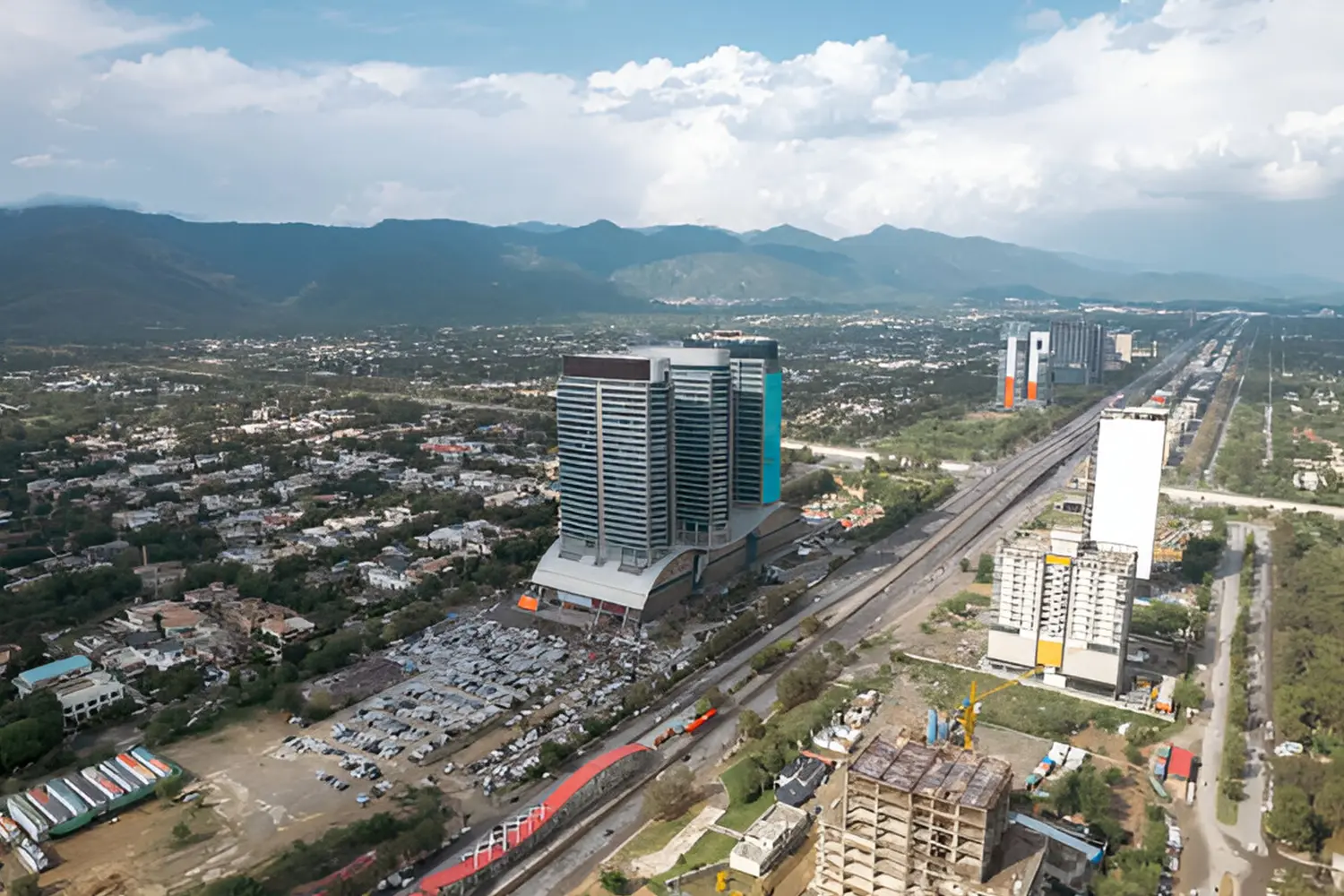
Real Estate Investment Insights from Islamabad, Karachi & Lahore
This researched article is specifically around ROI, rental yield, capital appreciation, cash flow, risk, holding period and exit/liquidity. The evidence points to a very important distinction:
Pakistani property is generally an appreciation-led investment, not a high-cash-flow investment. Our 2026 nationwide research puts gross residential yields around 3–6%, with houses around 3–4%, apartments around 4–6%, and commercial property around 6–9% but with higher risk. Bare plots produce no rental income.
Also, as of 14 September 2026, SBP’s policy rate is 11.5%, so financing cost remains an important hurdle for leveraged real estate investors.
Pakistan-wide investment picture
The first question an investor should answer is: What return engine am I buying?
A plot has essentially two return engines available as capital appreciation + eventual development/re-sale.
A completed house has also two return engines such as capital appreciation + rent.
An apartment has capital appreciation + rent, and normally a stronger rent-to-price relationship than a large house.
Commercial property can generate higher rental yield, but vacancy, tenant quality, maintenance, location and resale liquidity become more important. Our estimate roughly 6–9% gross for commercial versus 4–6% for apartments.
This is why a simple “property ROI” number is misleading.
An investor buying a Rs 3 crore plot cannot compare it directly with a Rs 3 crore rented apartment. The plot’s return is entirely dependent on future price appreciation; the apartment can generate current cash flow.
Rental yield
The documented 2026 estimates are fairly consistent:
| Asset | Indicative gross yield |
|---|---|
| Bare plot | ~0% |
| House | ~3–4% |
| Apartment | ~4–6% |
| Commercial | ~6–9% |
But gross yield is not cash in your pocket.
Vacancy, maintenance, service charges, management/agent fees, taxation and transaction costs reduce the actual return. Our property experts says a 4% gross residential yield falls to about 3.4% after operating costs.
So for investment content, we should always distinguish:
Gross yield = annual rent ÷ purchase price
Net yield = (rent − vacancy − maintenance − management − taxes − other recurring costs) ÷ total invested capital
That distinction is crucial.
Islamabad
Islamabad’s investment profile is relatively capital-appreciation + stability oriented.
At landspk our data shows Islamabad as the lowest-beta of the three major cities, with demand supported by government, diplomatic, corporate and overseas buyers. Its view is that prices tend to “grind rather than spike.”
Current data show substantial differences between locations.
For houses, July 2026 prices and one-year movements include:
B-17: +16%
DHA Defence: +9%
Top City 1: +9%
Gulberg: +11%
Faisal Town F-18: +17%
D-12: +8%
F-7: +8%.
That means Islamabad’s investment story is not simply “Islamabad property appreciates.”
It is:
specific locations + connectivity + development stage + end-user demand determine appreciation.
For rental investors, Islamabad’s residential yields are generally not spectacular. A 2026 Twin Cities analysis places typical residential gross yields around 3–6%, with roughly 4% described as normal for houses/apartments and 6–7% as stronger territory usually associated with smaller units or commercial property.
Islamabad cash-flow profile
Large houses in established sectors can have substantial rents, but the high capital value often compresses yield.
Therefore:
Large prime house: capital appreciation / wealth preservation play
Smaller apartment: better cash-flow proposition
Plot: appreciation only
Commercial: potentially stronger yield, but more location/tenant risk
Islamabad holding period
The expert material points toward a medium-to-long holding period, particularly for developing corridors.
A plot bought in a developing area should not be evaluated on a one-year horizon. The thesis depends on infrastructure, possession, occupancy and subsequent end-user demand.
Islamabad exit strategy
The critical issue is liquidity.
Established CDA sectors and mature DHA stock have an actual end-user market. A speculative file in a developing society depends much more heavily on investor sentiment.
That makes the exit strategy very different:
Mature built property → sell to end users/investors
File/development land → sell primarily to another investor
The second market can become much harder to exit when sentiment weakens.
Karachi
Karachi is the clearest income + appreciation combination among the three cities.
Karachi is Pakistan’s biggest and most liquid property market and says its deep apartment market produces gross residential yields of roughly 4–6% for well-located apartments, versus roughly 3–4% for houses in the more plot-oriented northern cities.
Our research data support a strong appreciation component as well.
For houses, July 2026 one-year movements include:
DHA Defence: +26%
Gulshan-e-Iqbal Town: +16%
Gulistan-e-Jauhar: +12%
Bahria Town Karachi: +12%.
For apartments:
Gulshan-e-Iqbal: +15%
DHA Defence: +6%.
Rent levels are also moving strongly. July 2026 apartment-rental index shows Karachi average apartment rent at about Rs135,000/month, up 20% year-on-year, with DHA up 22% and Clifton up 24%.
This creates something important for investors:
Karachi can produce both rising rents and rising property values.
That is the closest of the three cities to a genuine income-property market.
Karachi cash flow
The strongest candidates are generally:
2-bed / compact apartments near commercial plazas and employment centres
rather than extremely expensive houses.
The mid-2026 Karachi/Lahore comparison estimates mid-tier apartments around 5–7% gross, while settled high-end houses are roughly 3–4%.
That tells us why apartment investing is particularly relevant in Karachi.
Karachi risk
The main issue is that Karachi is extremely location-sensitive.
We describes a major divide: prime DHA and Clifton remain strong, while some outer Scheme 33 and Malir file markets have remained soft.
There is also the infrastructure factor. Water, security and service reliability can materially affect both rent and resale of the property.
So a higher nominal yield does not automatically mean lower investment risk.
Karachi exit strategy
Karachi’s large population and deep rental market provide a broad buyer/tenant pool, but the exit still depends heavily on product.
A completed, well-located apartment has multiple possible exits:
owner-occupier → rental investor → family buyer → resale
A speculative outer file has a much narrower exit pool.
That difference is fundamental.
Lahore
Lahore sits between Islamabad and Karachi in investment characteristics.
Lahore is having the highest transaction turnover among the major Pakistani markets, with a genuine end-user layer beneath the speculative market. It considers built houses relatively steady and says liquidity itself can justify paying a premium for established areas.
The real estate data show the difference between asset types very clearly.
For Lahore houses, the city average is relatively slow, while several individual locations have stronger appreciation.
But apartments are performing differently. July 2026 apartment prices were:
DHA Defence: +7% YoY
Gulberg: +9% YoY
Askari: +4% YoY
Bahria Town: +5% YoY.
Rental growth is also notable.
Lahore house-rent index shows:
DHA Defence: +20% YoY
Askari: +20%
Bahria Town: +11%
Johar Town: +9%.
So Lahore has a stronger cash-flow story than its citywide house-price appreciation alone might suggest.
Lahore rental yield
We can place Lahore houses around 3–4% gross, while its broader 2026 analysis shows apartments generally outperform houses for income.
Another 2026 Lahore analysis estimates gross residential yields around 2.5–7% depending on society and property, with net yields usually 1–1.5 percentage points below gross.
That variation is exactly what an investment analysis should highlight.
Lahore holding period
Lahore’s mature neighbourhoods and large developer ecosystem make it suitable for different horizons:
Short/medium-term: liquid developed plots in high-demand markets
Medium-term: built residential units
Long-term: development corridors where infrastructure and occupancy are still expanding
But Landspk specifically warns against paying premium prices for pre-possession files in unproven societies.
Lahore exit strategy
The strongest exit mechanism is generally a deep pool of actual buyers, rather than depending solely on another speculator.
That is why established DHA, Gulberg, Model Town and mature gated communities are continually discussed as liquid markets.
Capital appreciation vs cash flow
This is probably the most important investment comparison.
| Investment | Capital appreciation | Cash flow | Main risk |
|---|---|---|---|
| Bare plot | Primary return | None | Liquidity / development |
| House | Primary + rent | Low/moderate | High capital tied up |
| Apartment | Moderate/high + rent | Better | Oversupply / building quality |
| Commercial | Appreciation + rent | Highest potential | Vacancy / tenant / resale risk |
Our researchers specifically warns that apartments can become oversupplied, whereas plots cannot have an “oversupply of rent-paying tenants” in the same way, so the apartment investment thesis requires attention to future supply.
That is an important risk that gets ignored in many Pakistani property articles.
ROI: the number investors often get wrong
Suppose someone buys a Rs 3 crore apartment and receives Rs 12 lakh annual rent.
Gross yield:
Rs 12 lakh ÷ Rs 3 crore = 4%
But that is not their actual ROI.
Suppose they then incur vacancy, maintenance, management and other costs.
A simplified example:
Purchase: Rs 3 crore
Annual rent: Rs 12 lakh
Operating costs: Rs 1.8 lakh
Net rent: Rs 10.2 lakh
Net rental yield:
Rs 10.2 lakh ÷ Rs 3 crore = 3.4%
That is close to the worked example published by HydeRealtors.
Then there is capital appreciation.
If the property later sells for Rs 3.6 crore, the investor has:
Rs60 lakh capital gain + accumulated net rental income
But acquisition/sale taxes and transaction costs must also be deducted.
Therefore the real calculation is closer to:
Total ROI = capital gain + net rental income − acquisition costs − holding costs − selling costs − taxes
That is the number a serious property investor should use.
Risk
The experts’ material identifies several recurring Pakistan-specific risks.
1. File risk
A paper asset can remain dependent on future development.
2. Possession risk
A nominally cheap property can remain unattractive until roads, utilities, occupancy and services actually exist.
3. Liquidity risk
A property can have a high quoted value but still take a long time to sell.
4. Yield risk
A 4–5% gross yield can become substantially lower after costs.
5. Oversupply
Especially relevant to apartments and new commercial projects.
6. Regulatory/tax risk
Property investors face transaction and rental-tax costs, and these materially affect returns. Our real estate insiders specifically highlights the filer/non-filer difference as a significant transaction-cost issue.
7. Leverage risk
With SBP’s policy rate at 11.5% as of September 14, 2026, borrowing has a substantial opportunity-cost implication.
Holding period
There isn’t one correct holding period because the asset determines the strategy.
Plot in established high-demand location: commonly a medium/long-term appreciation strategy.
Development/file investment: generally needs a longer horizon because the investor is waiting for development and liquidity to mature.
Apartment: can work over a shorter horizon because rent provides an ongoing return, but transaction costs still discourage very short holding periods.
Commercial: potentially income-oriented, but vacancy can materially change the outcome.
The central principle is:
The more speculative the property, the more dependent the investment becomes on a long holding period and future development.
Exit strategy
This is where Pakistani property investment analysis is often weak.
Before buying a property, the investor should ask:
Who will buy this property from me?
For a DHA Karachi apartment, the future buyer could be an end user, landlord or overseas Pakistani.
For an Islamabad developed-sector house, the buyer pool includes families, diplomats, corporate tenants/investors and owner-occupiers.
For a plot file in an undeveloped scheme, the future buyer may mostly be another investor.
That means the exit strategy is fundamentally tied to liquidity and end-user demand, not just predicted price appreciation.
The three-city investment picture
| Islamabad | Karachi | Lahore | |
|---|---|---|---|
| Core return theme | Appreciation + stability | Rent + appreciation | Liquidity + appreciation |
| Residential gross yield | ~3–6% | ~4–6% apartments | ~3–4% houses; apartments can be higher |
| Apartment opportunity | Growing | Particularly important | Growing |
| Plot strategy | Important | Important but location-sensitive | Extremely important |
| Cash-flow potential | Moderate | Strongest of the 3 | Moderate |
| Main investment risk | Development-stage differences | Infrastructure/location polarisation | Overpaying for speculative/pre-possession property |
| Exit/liquidity | Stronger in established sectors | Deepest rental/buyer pool | Very strong established market |
The yield figures are indicative expert estimates, not guaranteed returns.
The most important finding
The research does not support the simplistic idea that:
“Property gives 10–15% ROI.”
Instead, the documented picture is:
Residential rent: usually only a few percent gross.
Capital appreciation: highly location- and asset-specific.
Total ROI: depends on appreciation + net rent − taxes/costs.
Plots: pure appreciation plays until developed.
Apartments: strongest residential cash-flow proposition.
Commercial: higher potential yield but higher operating/liquidity risk.
Established/possession property: generally has a broader exit market than speculative files.
And one particularly important 2026 point: current price growth should not automatically be treated as future ROI. The current data show very different one-year performance even within the same city—for example, Islamabad houses range from roughly 2% in Bahria Town to 17% in Faisal Town F-18, while Karachi ranges from 12% in Bahria Town to 26% in DHA.
1 Comment